
Key Considerations for Venue Operators Planning Event Security to Improve Emergency Response After On-Site Medical Emergencies at Large Public Gatherings
Introduction
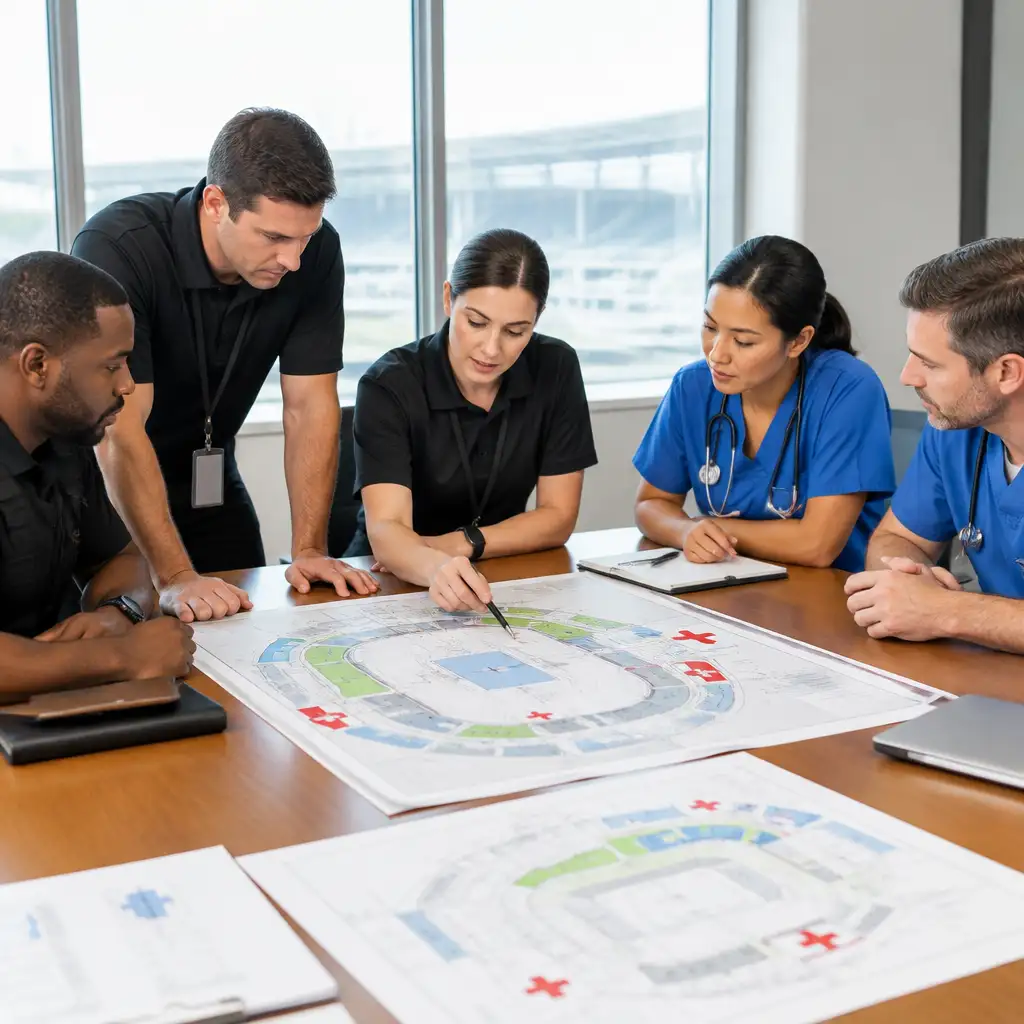
Large public gatherings create a complex risk environment where medical emergencies—from cardiac events to heat-related illness—can occur with little warning. Venue operators must integrate medical response into broader event security services so that response is timely, coordinated, and minimizes harm to attendees. Failing to plan for medical incidents increases organizational risk, operational disruption, and potential liability.
This article addresses practical planning priorities for venue operators: how to align crowd management, medical staging, access control, staffing, and evacuation procedures so emergency response is effective across event sizes and types. The recommendations reflect real-world security and healthcare preparedness principles and are intended for venue managers, event producers, and security leadership who must make decisions under time and resource constraints.
Audience includes venue operators, event organizers, public-safety partners, and senior staff responsible for site safety. Use this checklist to evaluate current plans, coordinate with EMS, and build a resilient response framework that protects attendees while supporting continuity of operations.
Pre-event risk assessment and medical planning
Start planning well before ticket sales or load-in. Conduct focused security security risk assessments that include medical threat scenarios, ambient risk factors (weather, crowd density, demographics), and site-specific constraints such as limited ambulance access or narrow exits. A robust assessment identifies the likely medical call types, peak demand windows, and critical access points for first responders.
Key planning tasks:
- Map anticipated high-risk areas (stages, concessions, VIP zones, youth areas) and overlay these with ingress/egress and vehicle access lanes.
- Estimate expected medical workload using event type, expected attendance, and historical benchmarks; use that to determine medical staffing and supplies.
- Agree on response roles and responsibilities with local EMS, fire, and law enforcement, and document mutual-aid expectations.
Integrate medical planning into your overall event security services planning to ensure medical response is not an afterthought but a coordinated element of public-safety strategy.
Medical staging zones and on-site EMS coordination
Designated medical zones speed assessment and treatment while reducing interference with crowd flow. Establish at least one primary medical treatment area close to traffic access and multiple secondary first-aid points distributed across the venue for rapid stabilization.
When coordinating with EMS:
- Define an EMS vehicle staging area that has direct access to patient transport routes and is kept clear by security staff.
- Agree on patient transfer points, radio channels, and documentation handoffs so transport to definitive care is seamless.
- Share site maps and medical zone locations in pre-event planning packets and during briefings so EMS arrives with situational awareness.
Staging should also consider privacy and clinical needs—ensure medical tents or rooms provide appropriate shelter for assessment, basic life support, and privacy for sensitive care.
Staffing, medical roles, and responder integration
Medical staffing decisions must reflect event scale and risk profile. Consider a layered approach: medical volunteers and first aid attendants for minor complaints; certified EMTs or paramedics for moderate events; and on-site physicians or advanced life-support teams for very large or high-risk events.
Operational guidance:
- Rosters. Create clear rosters that list roles, shift times, and contact points for each team member to avoid gaps during peak periods.
- Credentialing. Use visible credentials and a credentialing system so security staff and EMS can quickly identify medical personnel and authorized support staff.
- Responder integration. Conduct joint briefings and tabletop exercises with security, medical teams, and local EMS to practice handoffs, triage priorities, and patient transport under realistic constraints.
Cross-train selected security staff in basic life support and crowd techniques so they can provide effective initial assistance until clinical teams arrive. Consider certified security training for staff who will support medical response.
Crowd management and access control for medical response
Crowd dynamics are often the greatest barrier to timely medical access. Integrate crowd-management plans with medical access protocols so routes remain passable and victims can be reached quickly.
Practical measures:
- Dedicated lanes. Establish and signpost dedicated response lanes and barriers so responders have predictable routes through dense areas.
- Zone marshals. Deploy trained zone marshals whose role is to create temporary clearings for stretcher carry and to direct foot traffic during a medical incident.
- Access control. Use credentialed access points and electronic gates that can be overridden by incident command to open routes for ambulances and support vehicles.
Pre-event communications to attendees (programs, apps, signage) that explain emergency access points and instruct attendees to follow staff directions reduce friction when incidents occur and support orderly response.
Communications, incident command, and notification protocols
Clear communication channels and a single incident command structure help coordinate multiple responding agencies. Adopt an incident command approach tailored to your venue that designates a single point of command for medical incidents.
Communications checklist:
- Radio interoperability. Verify that venue security radios, on-site medical teams, and responding EMS can communicate on shared channels or have reliable radio gateways.
- Notification protocols. Use pre-defined notification trees for escalating incidents, including who notifies EMS, venue leadership, event management, and public information officers.
- Technology. Implement a mass-notification plan (PA, mobile alerts, digital signage) for public instructions during serious incidents without causing undue panic.
Regularly test radios, backup communications, and channel assignments during load-in and pre-event checks. Document the incident command roles and circulate them to all stakeholders.
Evacuation procedures, ingress/egress planning, and drills
Medical incidents that require evacuation or partial venue closure demand clear, practiced evacuation routes that account for medical transport needs. Integrate medical evacuation paths with general egress planning and be prepared to adapt routes if primary exits are compromised.
Planning actions:
- Overlay medical transport routes on the event evacuation map and ensure these routes remain free of obstructions during operation.
- Coordinate with local authorities on alternate transport options when roads are congested, including on-site stretcher carry routes to staged ambulances or helicopter landing zones if applicable.
- Run drills. Conduct full-scale or tabletop drills that simulate medical incidents, patient transfer, and evacuation to identify choke points and staffing needs.
After-action reviews should produce concrete follow-up items and timeline commitments for remediation. Include these results in your continuous improvement cycle for future events.
Frequently Asked Questions
Q: How many medical personnel should a medium-sized outdoor concert have on-site?
A: Staffing depends on attendance, event type, and risk assessment findings. As a baseline, pair volunteer first-aid attendants with at least two certified EMTs and a supervisory medical lead for medium-sized outdoor concerts; increase staffing if alcohol consumption, extreme weather, or dense crowding are expected.
Q: What is the best way to ensure ambulances can reach patients during peak crowd periods?
A: Designate and enforce dedicated vehicle lanes and patient transfer points, stage ambulances in pre-agreed zones with direct access to transport routes, and assign zone marshals and security staff to keep those lanes clear. Rehearse access procedures in pre-event briefings with EMS.
Q: How should venue operators balance medical privacy with public safety when treating patients in visible areas?
A: Use portable screens, covered treatment tents, or indoor medical rooms when possible to protect privacy. When treatment must occur in public, limit visible information and assign a privacy officer to control media and public movement while coordinating with public information personnel.
By adopting these planning elements—integrated risk assessments, deliberately staged medical zones, layered staffing, clear crowd-access strategies, interoperable communications, and practiced evacuation procedures—venue operators strengthen their event security services and reduce the time to definitive care when medical emergencies occur.
For organizations seeking structured evaluations and operational support, a professional assessment can identify gaps and translate planning into executable procedures. Consider engaging external expertise to augment in-house capabilities, especially for complex or high-attendance events.
Operational resources referenced in this checklist—training, risk evaluation, and formal security planning—align with broader goals of protecting attendees and preserving organizational continuity. For coordinated preparation that combines crowd management with emergency medical response, integrate these elements early in event planning and maintain regular training cycles.
Successful events require careful security planning long before attendees arrive. The Hemingway Group helps event organizers develop effective security strategies, crowd-management plans, and emergency response procedures designed to support safe and successful events.